If you have been diagnosed with Obstructive Sleep Apnea (OSA), you are on your way to better health. OSA is a very common condition, but it is also serious. The good news is that highly effective treatments exist.
The “gold standard” for treating OSA involves using a specialized device while you sleep. These devices, commonly called CPAP or BiPAP machines, are designed to keep you breathing through the night so you can get the restorative sleep your body needs.
What is Happening in Your Airway?
To understand how treatment helps, it is useful to see what happens when you sleep with OSA.
When you are awake, the muscles in your throat keep your airway stiff and open, allowing air to flow freely into your lungs. When you sleep, these muscles naturally relax.
For someone with OSA:
Those muscles, along with the soft tissue at the back of the throat (like the tonsils or soft palate), relax too much. When this happens, the airway physically collapses or becomes narrowed (obstructed). Your body has to work harder to pull air through, resulting in loud snoring.
When the airway collapses completely, you temporarily stop breathing (this is an apnea). Your brain senses the lack of oxygen and triggers a “micro-arousal”—a very brief wake-up that you usually don’t remember—just long enough for you to gasp for air and reopen the airway. This cycle can happen hundreds of times a night, shattering your sleep quality.
Your Treatment Options: The “Positive Airway Pressure” Solution
Both CPAP and BiPAP devices solve the problem of a collapsed airway using the same basic principle: Positive Airway Pressure (PAP).
Think of it like a pneumatic splint. The device takes in room air, filters it, pressurizes it gently, and delivers it through a tube to a mask worn over your nose, mouth, or both. This steady, gentle “splint” of air pressure pushes against the inside of your throat, preventing the soft tissues from collapsing and keeping the airway open.
Choosing Your Device
The machine your doctor prescribes is based on your specific health needs and comfort requirements. The two most common options are shown in the visual guide:
| Feature | CPAP (Continuous Positive Airway Pressure) | BiPAP (Bilevel Positive Airway Pressure) |
| How It Works | Delivers one continuous pressure level (e.g., 10 cm H2O) through the entire night. | Delivers two distinct pressure levels: higher pressure for inhalation, lower pressure for exhalation. |
| Key Distinction | The pressure is the same when you breathe in and when you breathe out. | Makes exhaling easier by decreasing the air flow when you breathe out. |
| Best For… | The standard and effective treatment for the majority of OSA cases. | People who require very high pressures or who have difficulty exhaling against a strong, constant flow of air. |
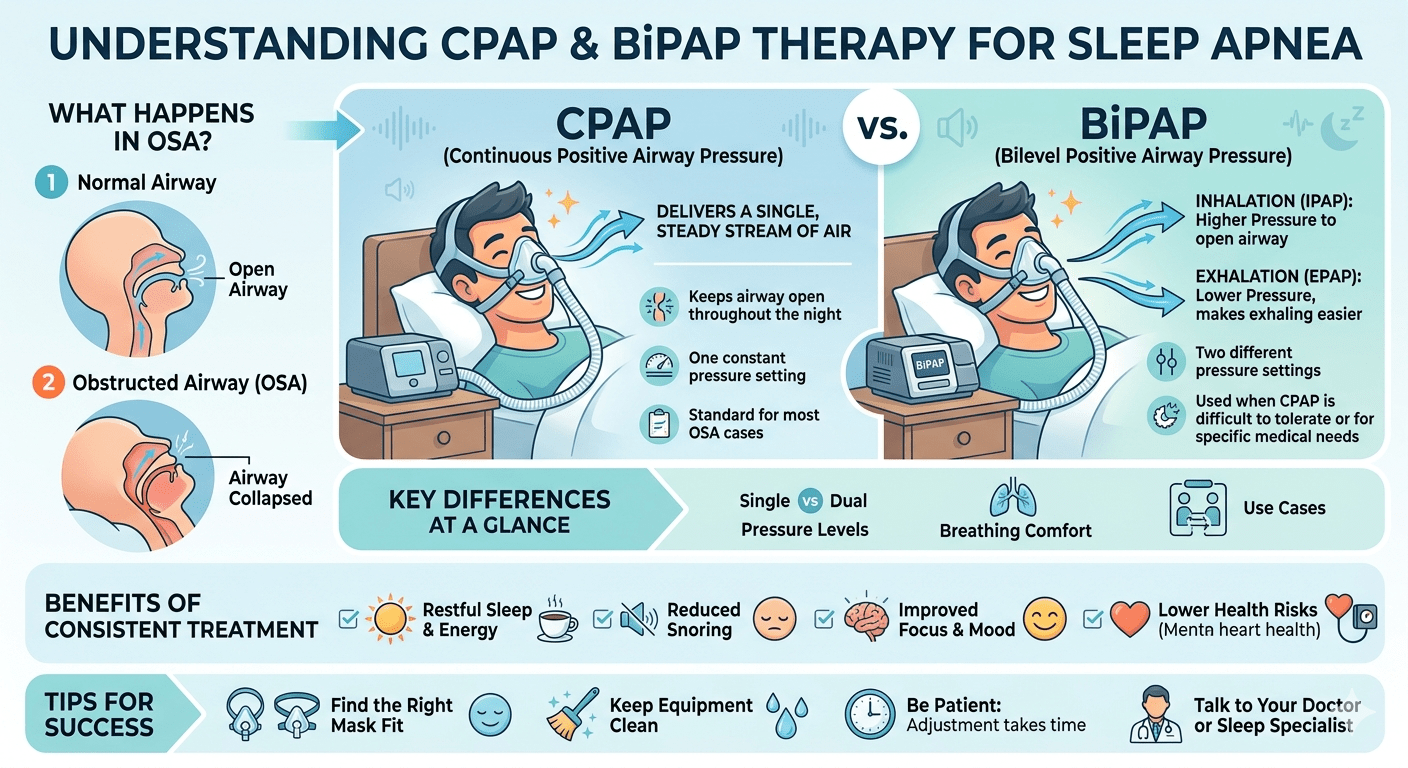
Why Treat Your OSA? The Benefits of Consistency
Treating OSA is about more than just a good night’s rest. It is a critical step for your overall health. The benefits of consistent treatment (meaning using your device every night) are profound:
-
Restful Sleep & More Energy: By stopping the breathing pauses, your body can finally cycle through the deep, restorative stages of sleep. You will wake up feeling refreshed instead of exhausted.
-
Reduced Snoring: When your airway stays open, snoring typically stops, creating a quieter environment for you and your partner.
-
Improved Focus & Mood: Better sleep is linked to better cognitive function (thinking, memory, attention) and better emotional regulation, reducing daytime sleepiness, irritability, and brain fog.
-
Lower Health Risks: This is perhaps the most crucial benefit. Untreated OSA puts a tremendous strain on your body. Treating it significantly lowers your risk for serious conditions:
-
High Blood Pressure (Hypertension)
-
Heart Disease and Heart Attacks
-
Stroke
-
Type 2 Diabetes
-
Atrial Fibrillation (irregular heartbeat)
-
Tips for Success and Getting Started
Adjusting to a PAP machine is a process. It is rarely comfortable on the very first night. However, with patience and the right support, most patients find it to be life-changing.
1. Find the Right Mask Fit (Crucial Step!)
The mask is the most personal part of therapy. There are three main types:
-
Nasal Pillow Mask: Small inserts that fit at the base of the nostrils.
-
Nasal Mask: A dome that covers your entire nose.
-
Full-Face Mask: Covers both your nose and your mouth (ideal for mouth breathers).
It is vital to work with your medical equipment provider to find a mask that is both comfortable and creates a perfect seal. If a mask leaks or hurts, you won’t use it. Don’t settle—ask to try different types!
2. Practice While You Are Awake
When you first get your machine, don’t just wait until bedtime. Sit in a comfortable chair and wear the mask (with the machine on) while watching TV or reading for 20-30 minutes a day. This helps your brain associate the mask with relaxation rather than struggle.
3. Keep Equipment Clean
Regularly cleaning your mask, tubing, and water chamber (if your machine has a humidifier) prevents bacteria and mold from growing. A clean machine is safer and works better.
4. Be Patient and Communicate
It can take 1-3 months to get fully used to sleeping with a machine. Don’t be discouraged. If you have any trouble—with pressure, mask comfort, dryness, or noise—call Pulmonary and Sleep Consultants immediately. Almost all problems have a solution (such as a different mask, adding humidity, or adjusting the machine’s settings).
You are taking a critical step toward a healthier, more energized life. Be proud of the commitment, and don’t hesitate to lean on Pulmonary and Sleep Consultants support.